One Size Fits None: Why the World's "Normal" Is Breaking People Like Me
What happens when the world is designed for a version of “normal” that doesn’t include you? Living with vision loss and AuDHD has shown me how systems built for the average person quietly leave many people working twice as hard just to exist in them.
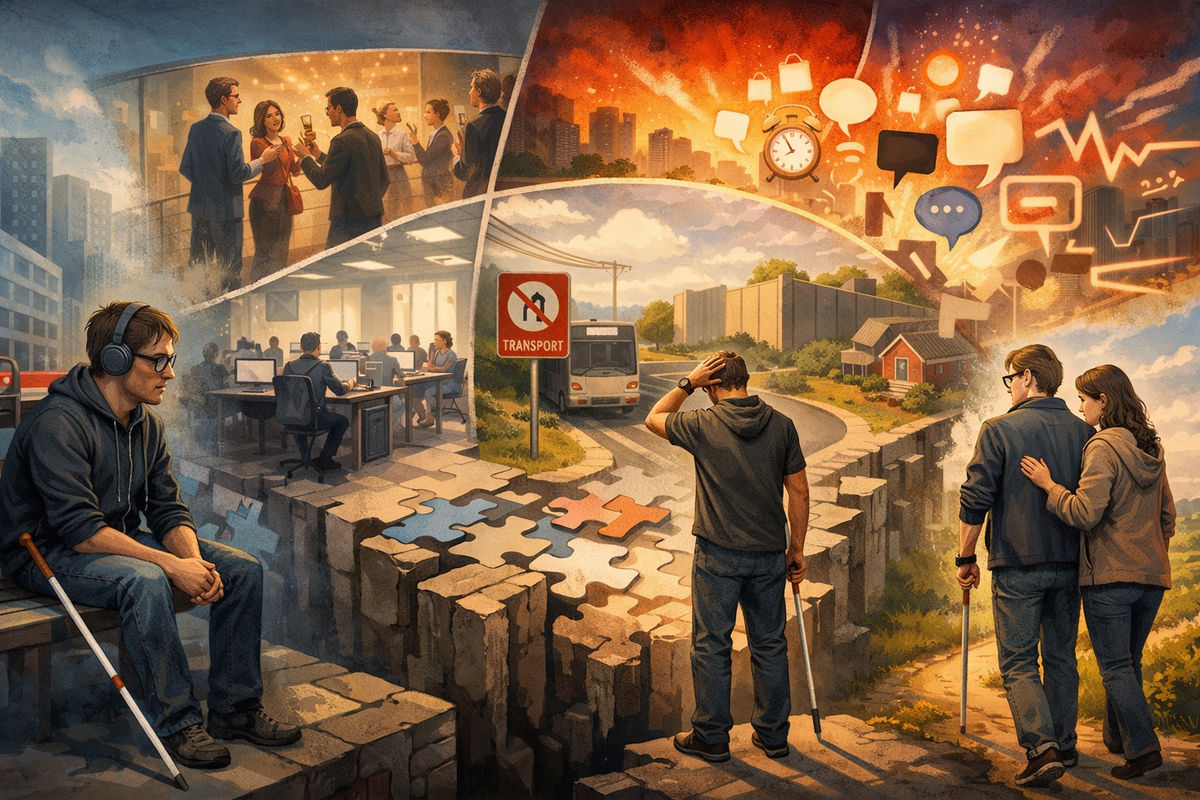
There's this assumption baked into almost everything, the way schools are designed, the way offices run, the way towns are built, the way people talk to each other at parties, that we are all basically the same. That we all process the world the same way. That we all move through it with the same ease. That if something works for most people, it works.
And I'm here to tell you that assumption is quietly, consistently, exhausting to live inside of.
I have a vision condition that makes everyday tasks harder than they look from the outside. I can't drive anymore. That word, anymore, matters more than it might seem. I used to drive. I had that freedom, that basic assumed-adult independence of just getting in a car and going somewhere. And then my vision dropped below the threshold, and that was it. Gone. Not gradually in a way you can prepare for, just, suddenly no longer an option.
In a lot of places, not driving would be an inconvenience. Where I live, it's something closer to a wall. Transit isn't an option. So everything runs through my wife now. Every errand, every appointment, every time I need to be somewhere, it has to fit her schedule. And because it has to fit her schedule, her schedule has to bend around mine too. We are both constantly working around a limitation that the world pretends doesn't exist, in a place built entirely around the assumption that every adult has a car and can use it freely.
There's a particular kind of guilt that comes with that. Not just the logistical frustration, though that's real, but the weight of knowing that your dependency has a cost for someone else. Someone you love. Someone who didn't sign up to be your transportation but does it anyway, without complaint, because that's just what the situation requires. The world didn't account for either of us in this. It just kept assuming, and we keep adapting.
Independence isn't something I lost dramatically all at once in some obvious, visible way. It's something that got quietly dismantled by a world that decided cars are the only answer and never left room for anyone who can't use one.
I also have AuDHD, autism and ADHD together, which is its own particular flavor of being wired differently. Socializing doesn't come naturally to me the way it seems to for other people. I don't always pick up on the unwritten rules everyone else seems to have downloaded automatically. Completing tasks, managing time, staying regulated in environments that weren't built with my nervous system in mind, these are real, daily challenges. Not excuses. Not laziness. Just the reality of a brain that runs on different hardware in a world built for different software.
And here's the thing I keep coming back to: none of this would be half as hard if the world just admitted we aren't all the same.
The Myth of the Default Human
Somewhere along the way, society built itself around a version of a person that doesn't actually exist in pure form. The Default Human. Can drive. Processes sensory information without it becoming overwhelming. Thrives in open-plan offices. Makes eye contact comfortably. Handles a 9-to-5 without their body or brain staging a protest. Can read standard-sized print, navigate a crowded event, follow rapid-fire verbal instructions, and make small talk without running a background script that's furiously trying to decode what everyone actually means.
This person is the assumed baseline. Everything gets designed for them.
The rest of us, the people with disabilities, the neurodivergent, the chronically ill, the people whose personalities and processing styles just don't fit the mold, we get handed a world built for someone else and told to figure it out.
And when we struggle? When we can't just "push through"? The world doesn't question its own design. It questions us.
When "Equal Treatment" Isn't Actually Equal
People talk about equal treatment like it's the goal. Treat everyone the same. Don't make exceptions. Be consistent.
But here's what equal treatment actually looks like when you apply it to unequal circumstances: it fails people. Consistently. Quietly. In ways that are easy to overlook if you're not the one being failed.
Take something as basic as getting to work. If your workplace assumes everyone drives or has reliable transit, and you have a vision condition that means you can't drive, and you live somewhere without transit, you are already behind before the day has even started. The system didn't account for you. It didn't have to. There were enough people it worked for that your situation never made it into the planning meeting.
Or take a social environment. A work team that bonds over after-hours drinks, impromptu hallway chats, and reading the room in real-time meetings. For someone with AuDHD, that environment isn't just uncomfortable, it's actively harder to navigate. The unspoken rules, the sensory noise, the expectation that you'll decode tone and subtext while simultaneously forming coherent sentences, it's a lot of parallel processing that doesn't happen automatically. And when you don't perform socialness the way everyone expects, you get read as rude, distant, weird, difficult. Not as someone whose brain is working overtime just to be in the room.
Equal treatment, in these cases, means everyone gets the same thing. But when the same thing was designed for a specific kind of person, "equal" quietly becomes "exclusionary."
The Invisible Tax
There's a concept sometimes called the "disability tax", the extra time, money, energy, and planning that people with disabilities spend just to access the same things everyone else gets by default. I think about this a lot.
For me, every outing requires logistical coordination that most people never have to think about. There's no "I'll just pop out." There's no spontaneous anything. Want to go somewhere? First, does it work for my wife's schedule? Does she have work, her own things to do, is this the third time this week I've needed to be somewhere, and is this ask going to be one too many? And then actually get there, and navigate an environment that wasn't designed with low vision in mind, poor contrast, bad lighting, cluttered signage, a world that assumes you'll just see things.
Most people don't factor another person's entire schedule into every single errand they run. I don't have a choice. And neither does she, she's absorbed into this logistical reality as much as I am, her day shaped by my needs in ways neither of us asked for. That's the hidden cost that never shows up in conversations about disability. It's not just the person with the condition paying the tax. It's everyone close to them too.
The AuDHD piece adds its own tax. Social situations require preparation and recovery time most people don't need. Unexpected changes to routine hit differently. Tasks that look simple from the outside can require an unreasonable amount of internal scaffolding to actually execute. And all of that effort is invisible to everyone else, because from the outside I'm just a person sitting there, and they have no idea what it took to get here.
The world doesn't charge this tax intentionally. But it charges it. Every day. To a lot of people who never asked to pay it.
"But You Seem Fine"
I want to talk about invisible conditions for a second, because there's a particular brand of dismissal that comes with them.
When a disability or difference isn't immediately visible, people default to assuming it isn't there. Or isn't serious. Or is being exaggerated. My vision condition doesn't announce itself. My AuDHD doesn't come with a visible marker. To most people in most moments, I seem fine.
"But you seem fine" is one of the loneliest sentences in the English language when you're not, actually, fine. When you're managing. When you've built a whole internal system to compensate for the ways the world doesn't accommodate you, and that system is exhausting to run, and no one sees the running, they just see the output and assume it cost you nothing.
This is what happens when the world treats everyone as the same: difference gets erased. The people who are working twice as hard to keep up get told they're keeping up just fine, as though the effort doesn't count, as though the cost doesn't exist.
The Personality Problem
It's not just disability, either. The world has a pretty narrow definition of how a person is supposed to function socially and professionally.
You're supposed to be comfortable networking. Supposed to enjoy collaboration. Supposed to be able to communicate clearly in any format, at any time, with any level of ambient chaos in the background. Supposed to interview well, shake hands confidently, make small talk at events without visibly calculating every response.
For people who are wired differently, whether that's neurodivergence, introversion, social anxiety, or just genuinely not being the default personality type workplaces were designed for, these expectations aren't neutral. They're a filter. And a lot of brilliant, capable, worthwhile people get caught in that filter and never make it through, not because they couldn't do the work, but because they couldn't perform the version of "normal" that the gatekeeping required.
I've felt this. The disconnect between knowing I'm capable and being in environments that make it nearly impossible to demonstrate that because the environment itself is the obstacle. It's a specific kind of frustration, not at yourself, but at a system that keeps measuring you with the wrong ruler.
What It Would Actually Look Like to Account for Difference
I'm not interested in pity. I'm not writing this to be told I'm inspiring or brave for getting through the day. I'm writing this because I think a lot of people genuinely don't realize how much of what they assume is "just how things work" is actually a series of design choices, and those design choices have real costs for real people.
What would it look like if we actually accounted for difference?
It would look like communities and workplaces that don't assume everyone has a car. It would look like flexible communication options so that people who process differently aren't constantly penalized for it. It would look like designing physical and digital spaces with a range of visual and sensory needs in mind, not as an afterthought, not as a "special accommodation," but as part of the baseline.
It would look like a culture that stops treating asking for what you need as weakness, and starts treating it as information. I need a different format. I need a different route. I need a different timeline. These aren't failure statements. They're just true things about real people.
It would look like employers who understand that productivity doesn't look the same for everyone, and that someone who needs to work differently isn't working less. Someone who needs more processing time, a quieter environment, written instructions instead of verbal ones, they're not a problem to be managed. They're a person whose needs are specific and legitimate and worth accommodating.
It would look like society finally letting go of the idea that the same approach produces the same outcomes for different people, because it doesn't. It never did.
A Note to Anyone Who Recognizes Themselves Here
If you read any of this and felt seen, if you've spent time in systems that weren't built for you, if you've paid the invisible tax, if you've been told you seem fine when you weren't, I just want to say that your experience is real and it makes sense that it's hard.
The world not being designed for you is not a personal failing. The exhaustion you feel navigating it is not weakness. The adaptations you've built are genuinely impressive even when no one notices them.
And the fact that you've had to work this hard for access that other people get by default? That's not something to be grateful for. That's something to be honest about. Loudly, if you can. Quietly, if that's all you have. But honest about.
Because the only way any of this changes is if the people designing things, the towns, the workplaces, the schools, the systems, actually understand that they've been building for a fictional average person, and that the real people they're building for are a lot more varied than that.
We are not all the same. We never were. And pretending otherwise has costs, and those costs land on the people who were already carrying the most.
It's time to stop designing for the myth and start designing for the actual humans.